What Is an E-Bike? A Plain-English Guide for UK Riders
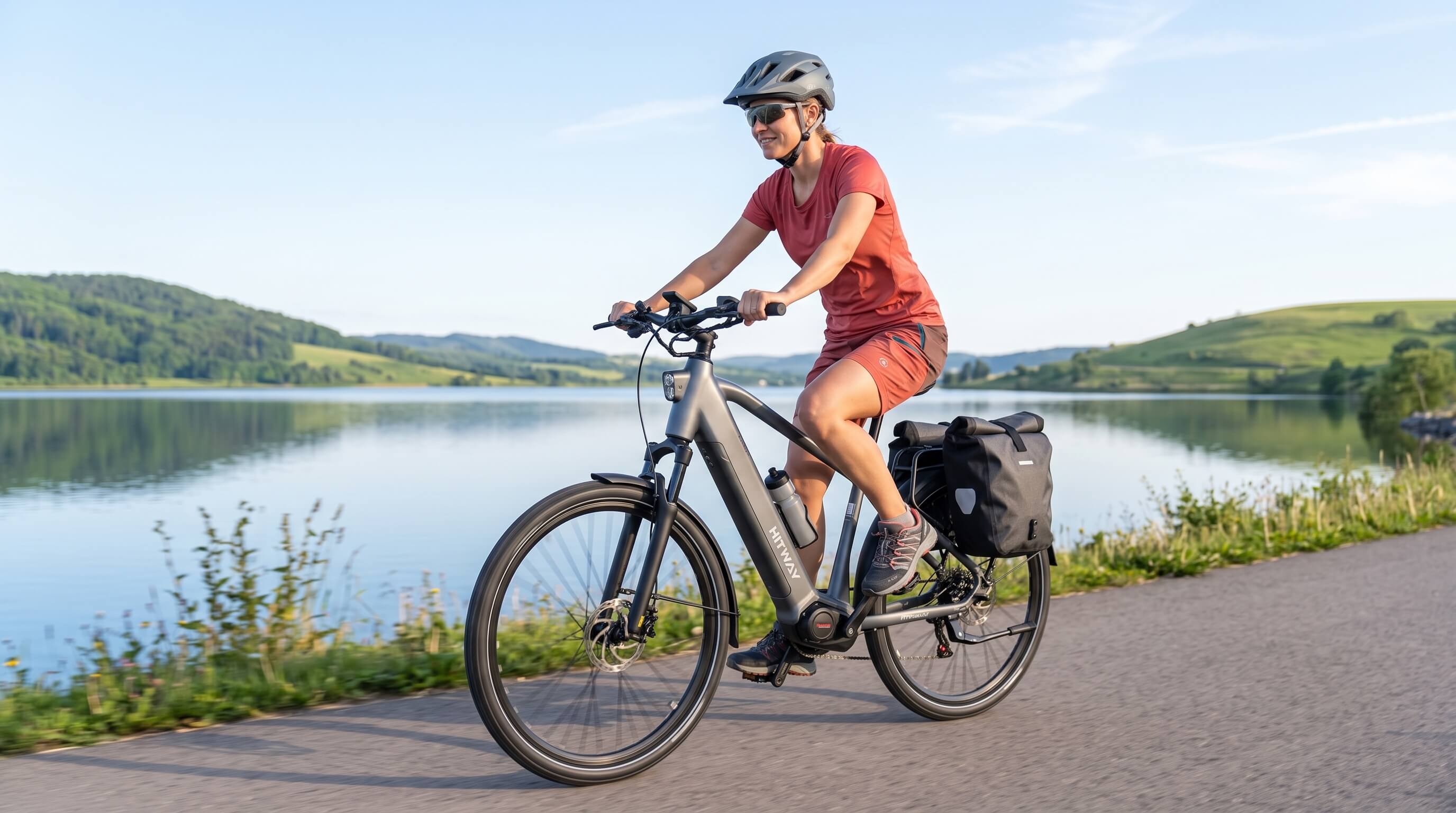
An e-bike, or electric bike, is a bicycle with a battery and an electric motor that assists your pedalling. You still pedal — the motor simply adds power, so hills feel flatter and longer trips take less effort. In the UK, an e-bike that meets four legal requirements is treated exactly like an ordinary bicycle, called an EAPC (Electrically Assisted Pedal Cycle). Meet them and you need no licence, no registration, no vehicle tax, no insurance and no MOT. Miss them and the same machine is legally a moped or motorcycle instead.
What is an e-bike, in one paragraph
An e-bike is a normal pedal cycle with three added parts: a motor, a battery and a controller that decides how much power to send where. The frame, wheels, gears and brakes are broadly familiar. The difference is that your legs are no longer the only source of power. Because the motor assists rather than replaces you, riding an e-bike still counts as cycling — you steer, balance and brake, and you decide how much help you want.
How the motor works: sensors, hub and mid-drive
The motor only knows when to help because a sensor tells it. Two sensor types dominate:
- Cadence sensor. Detects that the pedals are turning and switches the motor on. The response is simple and the cost is lower, but the power arrives a moment after you start pedalling, so it can feel less natural.
- Torque sensor. Measures how hard you are pushing on the pedals and matches the motor to your effort. It feels smoother and more responsive, and it tends to use the battery more efficiently.
Motors are mounted in one of two places. A hub motor sits in the centre of a wheel, usually the rear, and is simpler and cheaper to build and service. A mid-drive motor sits at the bottom bracket, between the pedals, and drives through the bike's gears — which makes it strong on steep climbs and gives a more balanced feel. Both are common; hub motors suit flatter commutes and lower budgets, mid-drive suits hills and heavier loads. Neither is right or wrong — the aim is simply a bike that responds the way you expect.
Battery and range: what Wh tells you
Battery capacity is measured in watt-hours (Wh), and the number is simply voltage multiplied by amp-hours. A 48V 15Ah pack is 720Wh. That figure matters more than voltage alone, because it is the closest guide to how much energy you actually carry and therefore how far you can go. A typical HITWAY e-bike is quoted at ranges such as 35–70 km or 60–100 km.
Range is a range, not a promise. Cold weather, hills, headwinds, heavy loads, more assist and more throttle-style riding all eat into it. Treat the top of the quoted figure as best-case and the bottom as realistic on a hard day.
If you ride the same route each day, work out the round-trip distance and add a margin for cold mornings and detours. A battery you rarely drain below about a fifth of its capacity will also last longer than one you constantly run flat.
Assist levels, throttles and walk-assist
Most e-bikes give you a handful of assist levels, usually one to five. Level one adds a light push for flat ground; higher levels add more for climbs but drain the battery faster. Choosing a low level and pedalling more is the simplest way to extend range.
A few e-bikes add a throttle, but in the UK a pure throttle (twist-and-go, no pedalling) is not legal unless the bike was sold before 1 January 2016 or has full vehicle type approval. Some models, including the HITWAY BK5S folding commuter, are designed as pedal-assist only for exactly this reason. Walk-assist is different and allowed: it nudges the bike along at up to 3.7 mph (6 km/h) while you push it, and it must cut out at that speed.
The UK rules that make an e-bike an EAPC
To be legal on public roads as an e-bike, a machine must meet four requirements:
- It must have pedals that can drive it forward.
- Its motor's maximum continuous rated power must be no more than 250W.
- Motor assistance must cut out at 15.5 mph (25 km/h).
- The rider must be at least 14 years old.
The frame must also be marked with the motor's continuous rated power and the manufacturer, plus either the battery voltage or the top speed. If a bike fails any of these, it is treated as a moped or motorcycle: you need a licence, DVLA registration, insurance, vehicle tax, a motorcycle helmet and type approval. Compliant e-bikes can be ridden on roads, cycle lanes and shared-use paths, but not on pavements (unless shared), footpaths or motorways. Riding outside the rules can lead to fines, penalty points and the police seizing the bike.
E-bike vs e-scooter vs moped
The three are often confused, but the UK treats them very differently.
| Vehicle | Licence needed? | Public roads? | Speed limit | Minimum age |
|---|---|---|---|---|
| Compliant e-bike (EAPC) | No licence, registration, tax, insurance or MOT | Yes — roads, cycle lanes and shared-use paths | Assist cuts out at 15.5 mph (25 km/h) | 14 |
| Private e-scooter | No legal route for private use | No — private land only; rental trial scooters are the only legal public use | Rental scooters capped at 15.5 mph (25 km/h) | 18 for rental pilots |
| Electric moped (L1e) | AM licence and CBT required | Yes, once registered, taxed and insured | Maximum design speed 28 mph (45 km/h) | 16 |
The pattern is clear: the e-bike is the only one of the three you can ride in public with no licence, no registration and no insurance.
Who an e-bike suits, and how to care for it
E-bikes fit a wide range of riders. Commuters gain from arriving without breaking a sweat, and a folding model such as the HITWAY BK5S folding e-bike suits mixed train-and-ride journeys. Everyday riders who want a conventional feel do well with the HITWAY BK15 Pro commuter e-bike. Riders who want stability on rough ground or longer range can look at the HITWAY BK9S fat-tyre e-bike with its 720Wh battery.
Your main use should shape the choice. A short daily commute rewards a lighter bike with just enough range for the round trip; a leisure rider who wants comfort on towpaths and gentle trails may prefer wider tyres and a more upright position; and a rider carrying shopping, tools or a child seat needs a stronger motor and stable handling. Decide how you will mostly ride, then let range and motor type follow.
Looking after an e-bike is close to looking after a normal bike, with battery care added. Keep tyres inflated and brakes adjusted, clean and lightly lubricate the chain, and store the bike out of the worst weather. For the battery, avoid running it flat often, do not leave it at 100% or 0% for long periods, charge in a cool dry place on a hard surface, use the supplied charger and never charge a damaged pack. As with any new bike, it is worth reading the warranty terms before you buy.
The bottom line
So what is an e-bike? It is a bicycle with a motor that helps you pedal, and in the UK a compliant one is legally just a bike — no licence, no tax, no insurance, no MOT, as long as it has pedals, no more than 250W and cuts out at 15.5 mph. Almost everything else is a detail about how the help feels and how far it takes you. If you are ready to choose one, browse all HITWAY e-bikes and match the model to the riding you actually do.


