What Is the Fastest Electric Scooter? The UK Answer Has Two Layers
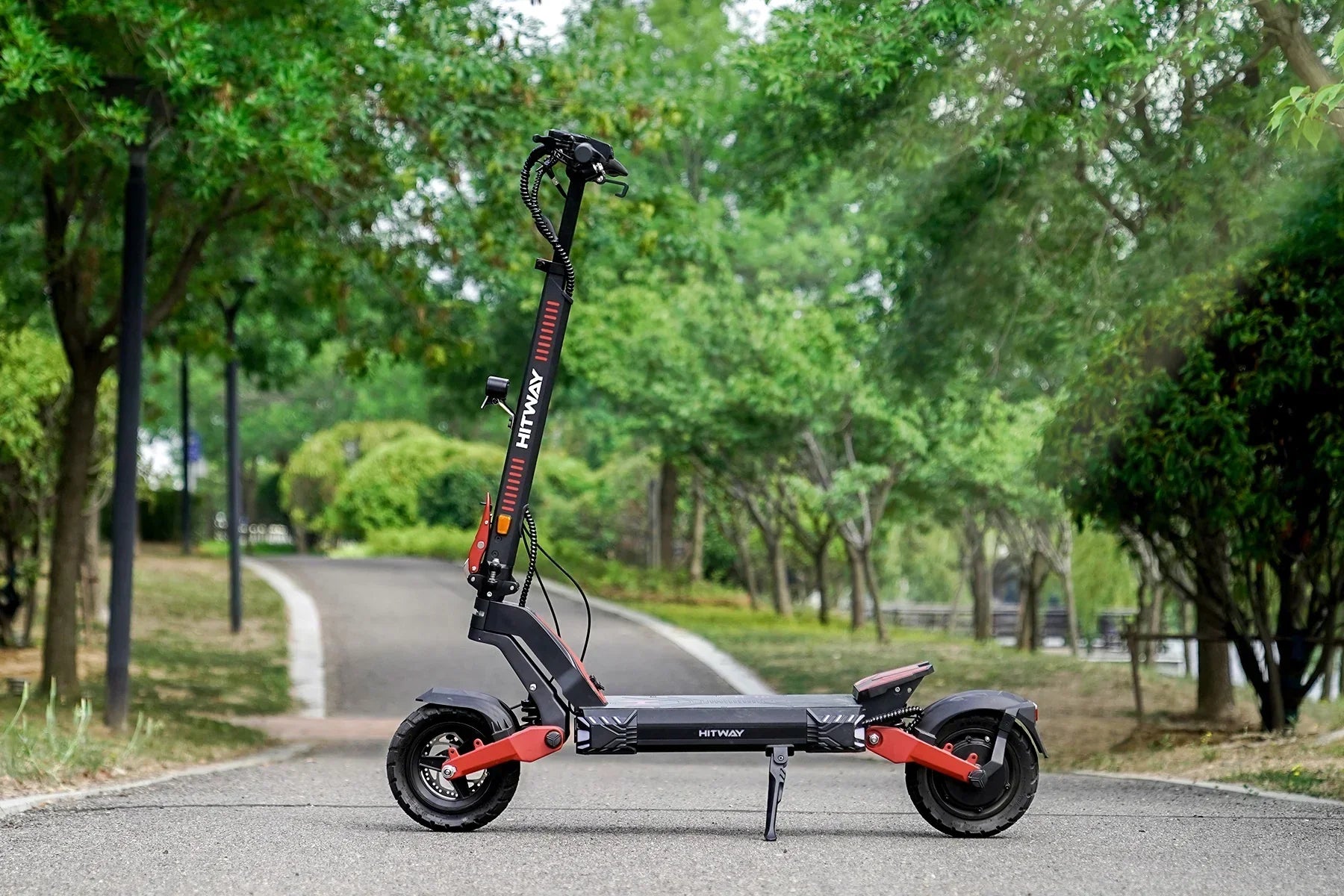
What is the fastest electric scooter? There are two honest answers, and they do not match. On a public road in the UK, the fastest you can legally go is 15.5 mph (25 km/h) — and only on a government-approved rental e-scooter. On private land, the ceiling is set by hardware rather than by law: HITWAY's H10 and H11 are rated 500W x 2 with 1600W x 2 peak, and their pages list an unlocked speed of 50 km/h. Which number applies to you depends entirely on where you ride, not on how much you spend.
The short answer, in one line each
- Legally, in public: 15.5 mph (25 km/h), and only on a rental pilot scooter.
- Off-road, on private land: up to 50 km/h on models such as the HITWAY H10 and H11.
This article is general information about UK law, not legal advice — check GOV.UK for the current position before you ride.
What the fastest legal speed is in the UK
If "fastest" means "the fastest I can legally ride in public", the answer is fixed at 15.5 mph (25 km/h). That limit applies to the government-approved rental e-scooter trials, which are the only place an e-scooter can be used legally in public. The national rental pilots have been extended to May 2028 — the fifth extension since they began in July 2020. In July 2026 the Department for Transport updated its rental guidance, adding Brighton and Hove, Cornwall and Plymouth, and removing Newcastle.
The rental rules matter because they define the ceiling. You must be 18 or over and hold a full or provisional UK driving licence with the right entitlement. You can ride in the pilot area on roads (but not motorways) and in cycle lanes, and you must not ride on pavements. The operator provides third-party insurance. The scooter itself is capped at 15.5 mph. No private e-scooter gets to inherit those conditions just by matching the speed. The UK driving licence Q category, for instance, covers two- and three-wheeled vehicles without pedals, up to 50cc, with a maximum design speed of 15.5 mph.
Why a private e-scooter is illegal in public, whatever its speed
Under the Road Traffic Act 1988, a privately owned e-scooter is a motor vehicle and a powered transporter. To be used on a public road it would need insurance, DVLA registration, vehicle tax, a driving licence and compliance with vehicle construction standards — and a privately owned e-scooter cannot satisfy those requirements. That is why private e-scooters are illegal on public roads, cycle lanes, pavements and in parks.
Buying and selling them is not illegal. Owning one is not illegal. Riding one is legal only on private land, with the landowner's permission. So a private scooter is a machine for a yard, a field or a private track — not for the road home. Speed does not change that: a slow private e-scooter is just as illegal in public as a fast one.
One detail trips people up. Some HITWAY e-scooters carry a German ABE (Straßenzulassung), which is a German type approval for German roads. A German approval does not make a scooter legal in the UK. It is a German-market document, not a British one. The confusion matters: around one million privately owned e-scooters are thought to be in the UK, and the Motor Insurers' Bureau reported close to £47 million in micromobility-related claims in 2025.
How fast do HITWAY e-scooters go off-road?
Here the answer moves from law to hardware. Used on private land as intended, the dual-motor HITWAY models are built for riders who want more than a city commuter can give. The headline figures are a rated 500W x 2 motor set, 1600W x 2 peak, selectable 10 / 15 / 25 km/h speed modes, and a listed unlocked speed of 50 km/h.
| Model | Speed modes | Unlocked speed | Range | Battery |
|---|---|---|---|---|
| HITWAY H10 | 10 / 15 / 25 km/h | 50 km/h | 90–100 km | 48V 28.6Ah |
| HITWAY H10 (smaller pack) | 10 / 15 / 25 km/h | 50 km/h | 90–100 km | 48V 20.8Ah |
| HITWAY H11 | 10 / 15 / 25 km/h | 50 km/h | 90–100 km | 52V 23.4Ah |
Both share a 10 x 3-inch tubeless tyre and a 33.5 kg build. Speed modes let you keep the scooter tame indoors or on a tight track, while the higher settings are for open private ground. If you want the full specifications, see the HITWAY H10 dual-motor e-scooter and the HITWAY H11 dual-motor e-scooter.
The trap behind "fastest electric scooter" searches
The phrase hides a contradiction. Because there is no legal route for private e-scooters in the UK at all, "fastest" and "road-legal" pull in opposite directions. The quicker a model is, the further it sits from anything you could legally ride in public — and no amount of specification closes that gap.
Marketing language makes it worse. "Fastest" is often sold through peak power figures, which describe a brief surge, not sustained output. A scooter advertised at 1600W peak may be rated at 500W continuous. Both numbers are real; they simply describe different things, and mixing them up leads buyers to expect speed the machine will not hold on a hill.
What affects real speed, and what else to compare
Top speed is not one number. It is the result of several factors working together:
- Rated versus peak power. Rated power is what the motor sustains; peak power is a short burst for acceleration or climbs.
- Controller current. The controller decides how much power actually reaches the motors, whatever the motor is capable of.
- Rider weight. Heavier riders reach a given speed more slowly and lose more on gradients.
- Gradient. A steep hill can cut real speed sharply, especially with a single motor.
- Battery charge. As the pack drains, voltage falls and top speed with it. A full battery and a low one rarely feel the same.
- Tyres and pressure. Under-inflated or too-small tyres add rolling resistance and blunt acceleration.
Beyond those factors, top speed is only part of the picture. Chasing the highest figure is the wrong way to buy, because what keeps a scooter useful and predictable is everything around the motor:
- Brakes. Strong, well-modulated braking matters more than a top-speed claim.
- Suspension. Good suspension keeps the tyres on the ground, which is what speed actually depends on.
- Tyres. Size, tread and tubeless construction all change grip and comfort.
- Water resistance. Relevant if you ride where weather and puddles are unavoidable.
- Range. A 90–100 km range is only useful if the ride you plan fits inside it.
Riding, safety and charging
Whatever the model, ride within your limits and gear up: a helmet and protective equipment are basic, not optional. Keep to private land you have permission to use, and stay off public roads, pavements and parks. When charging, use the supplied charger, charge on a hard non-flammable surface, keep the pack away from anything that can catch fire, and never leave a charging battery unattended or charge it overnight in a hallway or by an exit.
The bottom line
There is no single fastest electric scooter, because the UK answer and the hardware answer are different questions. If you want to ride legally in public, the ceiling is 15.5 mph on a rental pilot scooter, and no private model changes that. If you want genuine performance on private land, dual-motor machines such as the H10 and H11 list 50 km/h unlocked with a 90–100 km range. Match the scooter to where you actually ride, then compare the brakes, tyres and range that decide how it feels. You can browse the full e-scooter range to see which model fits your private-land riding. This article is general information about UK law, not legal advice — check GOV.UK for the current position before you ride.


